
Status update — 26 August 2026: this launch record has been superseded by Tin Man OS v0.7.0-rc.1 Citadel, the software-qualified release candidate. TMOS-0 through TMOS-7 are complete and TMOS-8 final physical qualification is active. Read the current release record.
From a model that answers to a system that operates
Reinventy Solutions Corp. today introduced Tin Man OS, its commercial operating-system product line for sovereign synthetic intelligence at the physical edge.
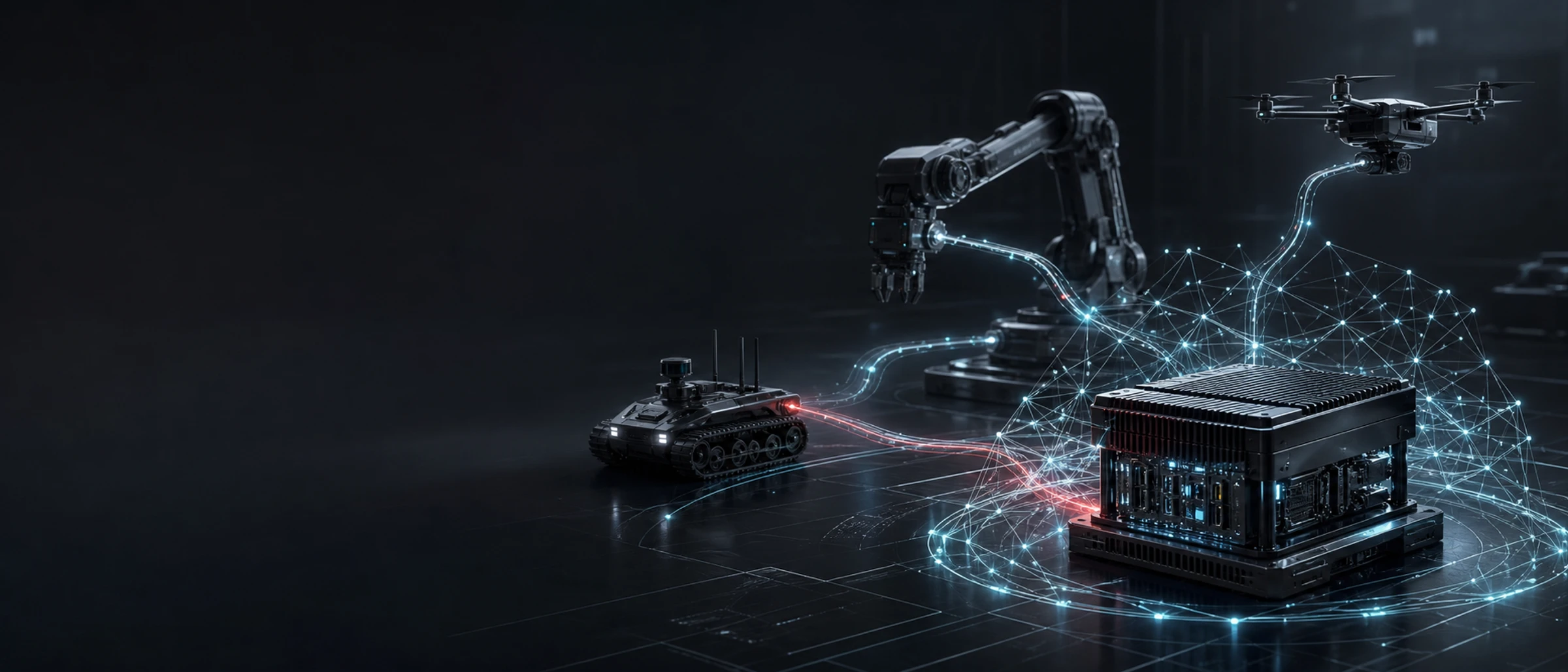
The product starts from a simple conviction: the next decisive advance in artificial intelligence will not be another isolated model or another agent living inside a browser. It will be the operating layer that enables a synthetic brain to understand the machine it inhabits, perceive the world around it, preserve operational memory, use bounded tools and remain subordinate to an authority plane it cannot rewrite.
Tin Man OS is being engineered for that category.
It composes a reproducible Linux and BSP foundation, a versioned hardware-abstraction layer, the Tin Man multimodal cognitive runtime, domain-specific packs, governed actuation contracts, cockpit observability and a physically separate constitutional plane. The result is intended to be a product line rather than a one-off integration: one architecture, resolved through explicit machine, mission, domain and governance manifests for different bodies and operating environments.
The launch alpha and its declared proof boundary
At launch, v0.2.0-alpha.1 closed the TMOS-2 image-artifact gate for NVIDIA Jetson AGX Thor. Its public evidence package recorded:
- 7,609 of 7,609 BitBake tasks completed successfully;
- a cached replay matching 7,609 of 7,609 tasks with 100% sstate reuse;
- 12 of 12 SHA-256 manifest entries verified;
- 13 release artifacts totaling 2,242,623,265 bytes;
- 10 of 10 backend qualification tests passed;
- an SPDX image software bill of materials and release provenance;
- zero production, Guardian or policy mutations.
This is a meaningful engineering milestone, but its boundary is equally important. The alpha proves a pinned, reproducible and integrity-verifiable image foundry. It does not yet claim exact-L4T boot qualification, production flashing or physical actuation. Those steps remain explicitly deferred to separately authorized, non-production media and later validation gates.
Built on NVIDIA accelerated edge computing
NVIDIA Jetson AGX Thor was established as the first hardware target in the Tin Man OS roadmap. TMOS-3 then moved into versioned providers for CUDA compute, camera integration and ROS 2/DDS messaging, alongside a governed actuator bridge disabled by default and dependent on an external safety gate.
This target is not incidental. Reinventy is developing Tin Man OS for the class of systems in which accelerated perception, multimodal reasoning and local autonomy must coexist inside a constrained power, memory and latency envelope. Jetson AGX Thor provides the first Blackwell embedded foundation for proving that architecture.
Reinventy is a member of NVIDIA Inception. NVIDIA has not sponsored, certified or endorsed Tin Man OS, and NVIDIA and Jetson remain trademarks of NVIDIA Corporation.
The operating architecture behind the product
Tin Man OS is not positioned as a new kernel. Its differentiation lies in the layers required to convert advanced models into an accountable operating capability:
- Foundry — resolves machine, mission, domain and governance manifests into one reproducible image and evidence set.
- Foundation — pins the Yocto/OpenEmbedded release, BSP, boot chain, kernel and root filesystem for the selected machine.
- Versioned HAL — exposes compute, cameras, messaging, sensors, buses and governed actuation through stable contracts.
- Cognitive runtime — integrates perception, memory, evidence, reasoning, planning and specialist cores as one operating fabric.
- Governed tools — makes physical or digital capabilities typed, risk-classed, bounded and observable.
- Constitutional plane — keeps Guardian, policy, Principal authority and kill-switch paths outside the cognitive runtime.
- Lifecycle — adds cockpit truth, signed updates, recovery and rollback to the product architecture.
The moat is therefore not one foundation model. It is the system-level composition that makes multiple models, sensors, tools and machine contracts operational without giving the intelligence authority over its own constitutional boundary.
One OS, multiple bodies
The initial product-line architecture defines eight domain editions:
- Tin Man OS Flight for uncrewed aircraft, aerial sensing and governed mission intelligence;
- Tin Man OS Robotics for humanoids, manipulators, mobile robots and adaptive physical work;
- Tin Man OS Industrial for production, inspection, maintenance and brownfield orchestration;
- Tin Man OS Drive for special-purpose vehicles and autonomous ground platforms;
- Tin Man OS Marine for surface, subsea and persistent ocean systems;
- Tin Man OS Materials for evidence-governed scientific discovery and laboratory integration;
- Tin Man OS Motor for electric-machine diagnostics and lifecycle intelligence;
- Tin Man OS Energy for distributed generation, storage, microgrids and critical infrastructure.
Three additional sectors—Medical, Space and Agriculture—have entered strategic evaluation. They are not released product editions. Their public pages define the questions, potential capability envelope and evidence boundaries that would need to be resolved with qualified partners before any product or regulatory claim could be made.
Industrial first; strategically relevant where sovereignty matters
Tin Man OS is designed first as an industrial and scientific platform. Its architecture can also be relevant to aerospace, intelligence, security and defence integrators, including autonomous and remotely supervised aerial systems, where disconnected operation, data sovereignty, visible authority and local multimodal reasoning matter.
Reinventy does not operate missions and does not assume end-use command. It develops the governed operating layer and qualifies integrations with partners. Deployment authorization, regulatory compliance, operational command and physical safety remain with the qualified operator and the applicable human authority.
The partnership window
The product has reached the point at which its next value will be created with reference partners: silicon and accelerated-compute leaders; robot, vehicle, drone and marine OEMs; industrial and energy integrators; scientific institutions; and strategic investors able to support qualification, commercialization and global platform development.
For OEMs, Tin Man OS offers a path to differentiate the intelligence of the machine without rebuilding the entire operating architecture for every programme. For industrial partners, it offers a sovereign edge layer that can bridge existing assets while preserving deterministic control. For strategic capital, it presents a repeatable platform thesis across multiple high-value verticals rather than a single application company.
The verified alpha was the beginning of that commercial path—not the end of the engineering work. At launch, TMOS-3 became active; the programme has since advanced through the later reference-profile, lifecycle, SDK and compliance gates documented in the current Citadel release-candidate record.
Reinventy is now opening structured discussions for alpha access, reference integrations, NVIDIA ecosystem collaboration and strategic investment.
Sources: Tin Man OS canonical Forgejo record · ROADMAP.md · ARCHITECTURE.md · TMOS2_RELEASE_EVIDENCE.md · commit 151bd666d2 · reviewed 2026-08-25