
REINVENTY AI LAB · APPLIED SYNTHETIC COGNITION
One mind.
Many domains.
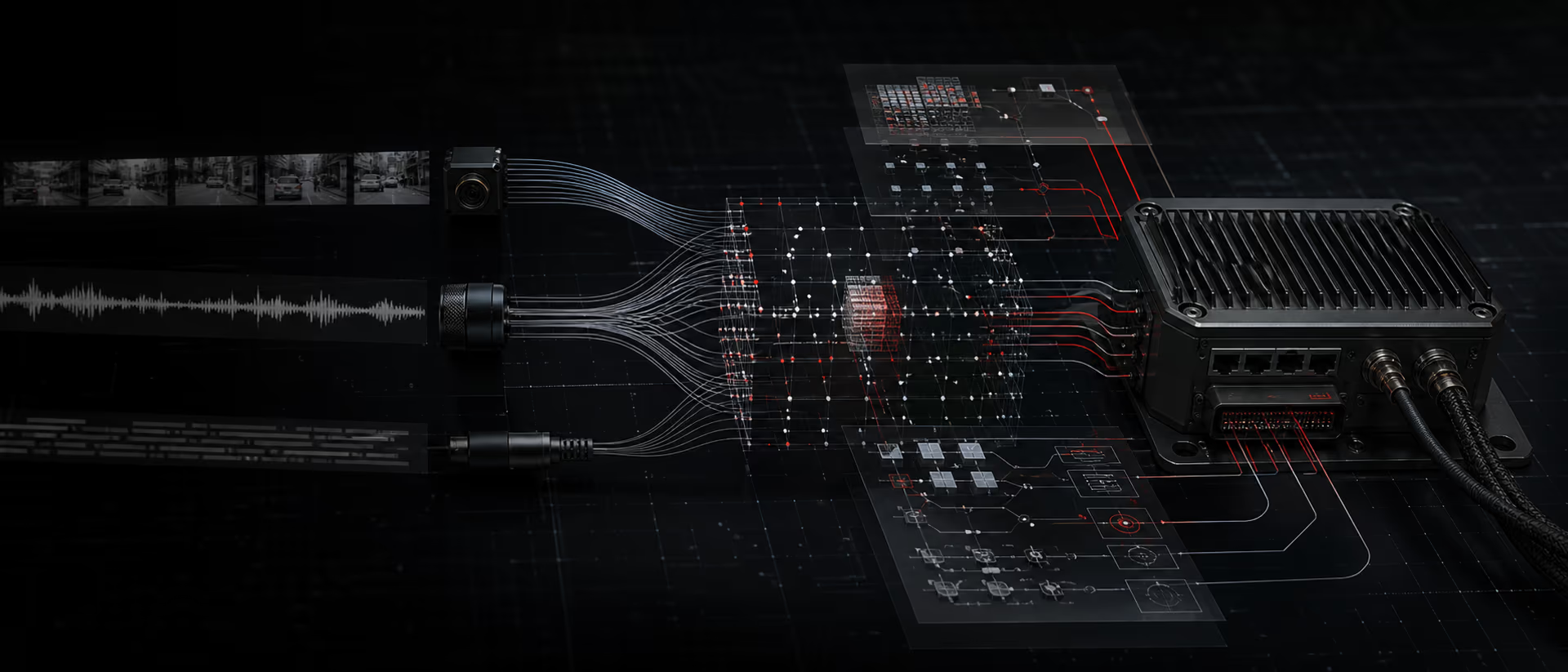
Tin Man is becoming a governed synthetic copilot: a cognitive architecture that can observe, reason, plan and support action inside a precisely bounded mission. AI Lab is where we test that capability against real technical domains.
L4 refers to software-qualified, bounded workflows. It is not a claim of general intelligence, unrestricted autonomy or physical-system qualification.01THE THESIS
A synthetic brain should not be built for a single interface.
Tin Man is the cognitive architecture. Tin Man OS turns it into a licensable, hardware-aware operating capability. AI Lab applies that core to specific missions, evidence rules and authority boundaries—so the same foundation can become a financial research copilot, an industrial observer or a governed autonomy layer.
FROM FOUNDATION TO FIELD SYSTEM
Specialisation without surrendering control.
Every deployment combines the same governed cognitive spine with domain data, tools, policies and human authority.
- 01Tin Man
Multimodal interpretation, planning and reasoning.
- 02Domain pack
Vocabulary, evidence, tools and objectives for one field.
- 03Governance
Permissions, risk gates, audit and explicit human authority.
- 04Field system
A focused copilot that observes continuously and acts only inside its mandate.
FIRST FIELD APPLICATIONARCPRIVATE R&D · SHAREHOLDER ACCESS
FINANCIAL RESEARCH, NOT FINANCIAL MANAGEMENT
The market is the laboratory.
The user keeps authority.
ARC applies Tin Man to continuous financial research. It observes configured sources, connects market data and events, evaluates cost and risk, and turns large information flows into explainable research candidates. Each authorised participant receives a separate, tenant-scoped environment.
ARC is technology supplied by Reinventy. It is not a broker, exchange, custodian or investment adviser. After individual activation, the agent can operate and execute the user's instructions only within the permissions and precise loss limits authorised by that user. This phase verifies execution quality, stability and the ability to pursue continuous daily profitability after costs and risk; no return or profit is guaranteed.
APPLICATION HORIZON
One cognitive foundation.
Six mission spaces.
Financial research
Continuous observation, explainable signals and governed execution within user-defined permissions and risk limits. ARC is the first private field application.
Defence & security
Decision support, mission context, controlled autonomy and operator authority for demanding environments.
Intelligence
Source correlation, provenance, anomaly detection and evidence-led prioritisation across large information spaces.
Industry
Persistent monitoring, production support, asset coordination and human-supervised execution across complex operations.
Research & development
A synthetic research partner for hypothesis generation, structured experimentation and traceable technical work.
Physical autonomy
A governed cognitive layer for robotics, aerial, maritime and ground systems, with safety authority kept outside the model.
THE OPERATING PRINCIPLES
Capability earns trust through constraints.
- 01Evidence before confidence
Sources, state and decisions remain traceable.
- 02Authority stays explicit
No deployment silently expands its own mandate.
- 03Abstention is a feature
When evidence or permissions are insufficient, the system stops.
- 04Qualification is domain-specific
Software evidence in one field does not certify another.
AI LAB · REINVENTY SOLUTIONS CORP.
Build the copilot
your domain requires.
AI Lab is the route for selected partners, researchers and operators who want to evaluate Tin Man against a concrete mission with clear evidence and authority boundaries.
Start a research conversation →