
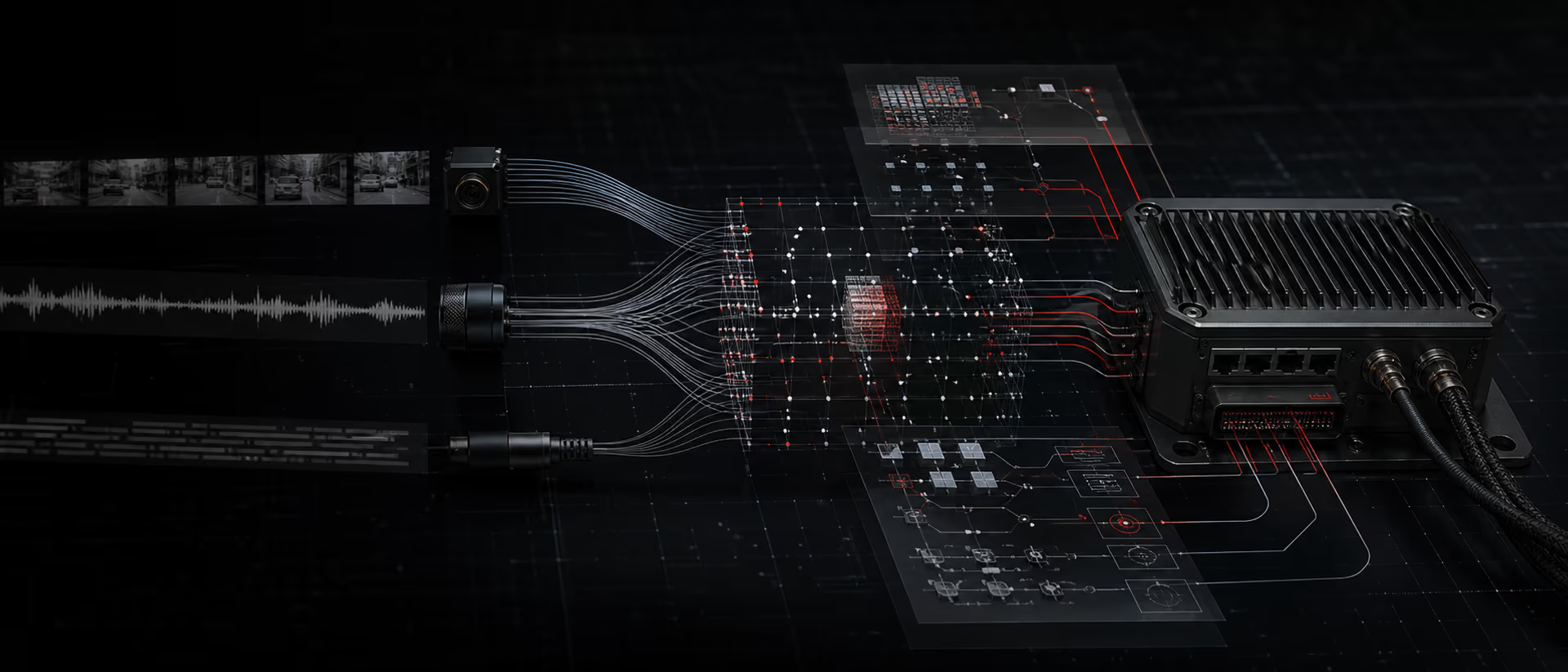
TIN MAN v5.0 · DEFINITIVE L3 · COCKPIT V3 v5.37
Tin Man v5.
Intelligence, governed into action.
A sovereign cognitive architecture that sees, hears, speaks, reasons and can carry an authorized objective through to completion on a single NVIDIA Jetson AGX Thor. L3 is definitive. L4 remains human.
26-CORE FLEET · SOVEREIGN EDGE · VISIBLE HUMAN AUTHORITYCOMMERCIAL PRODUCT · CITADEL RELEASE CANDIDATE
Eight tracks closed. The final qualification phase is active.
A reusable commercial architecture for flight, robotics, industrial systems, mobility, marine, energy and materials—without rebuilding the intelligence stack for every machine.
Enter Tin Man OSRELEASE TRUTH · GOVERNED RECORD · 12 JUL 2026
Tin Man v5.0
Definitive L3.
COCKPIT V3 · CURRENT RELEASE LINEv5.37
Voice navigation, persistent dialogue, scene description and hardware-node speech—inside the same visible governance boundary.
- v4.0ProductionOperational package
- v4.5VitalsProduction proof
- v4.8TruthRecord reconciled
- v5.0DefinitiveL3 capstone
- v5.37CockpitVoice console navigation
Command to completion
Spoken intent, dialogue, governed execution and completion—under explicit human authorization.
26-core live fleet
Perception, cognition, memory, science, voice and governance coordinated on one sovereign edge node.
Failure made visible
Health matrix, crash recovery, liveness and planned capability appear as operating state, not hidden assumptions.
L4 stays human
The system is L3 definitive. Physical autonomy beyond that boundary requires a separate, explicit human-authorization decision.
COCKPIT V3 · SOVEREIGN EDGE HUD
The machine does not disappear behind a prompt.
It makes its state visible.
Tin Man’s cockpit is the operational surface of the cognitive architecture: perception, voice, reasoning, system health and human authority share one live visual language.
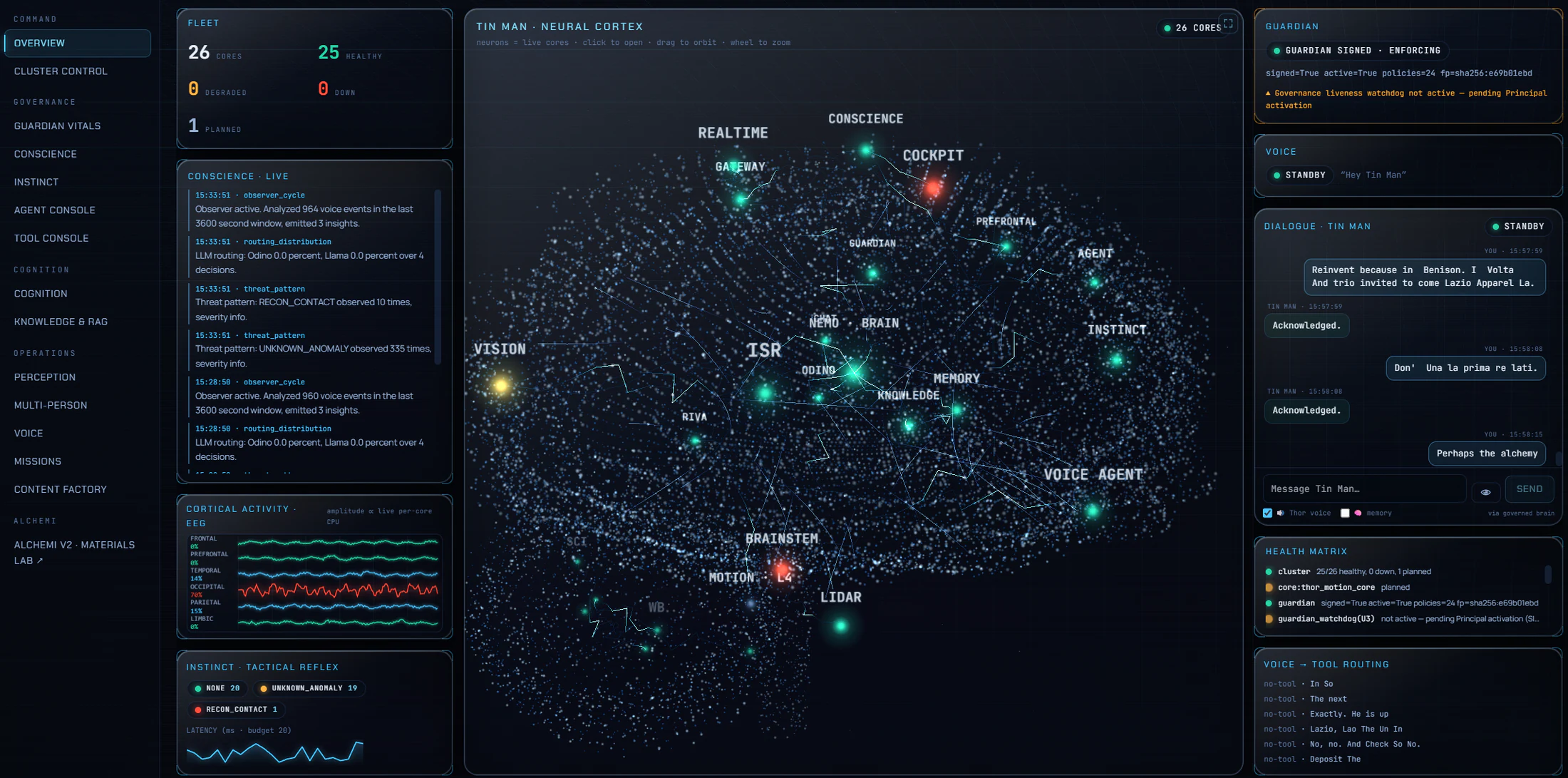
01 · SYSTEM TRUTH
A cockpit that exposes what is alive, what is planned and what requires authority.
The overview combines live fleet status, neural-cortex topology, Conscience observations, Guardian enforcement, dialogue, voice state and the health matrix. At capture time it reported 26 cores, 25 healthy, zero degraded, zero down and one planned.
- VISIBLEFleet, cognition, dialogue and enforcement state
- BOUNDEDPlanned capability remains explicitly planned
- HUMANGoverned actions remain under explicit human authority
02 · VOICE AS AN OPERATING LAYER
“Hey Tin Man” is not a browser trick.
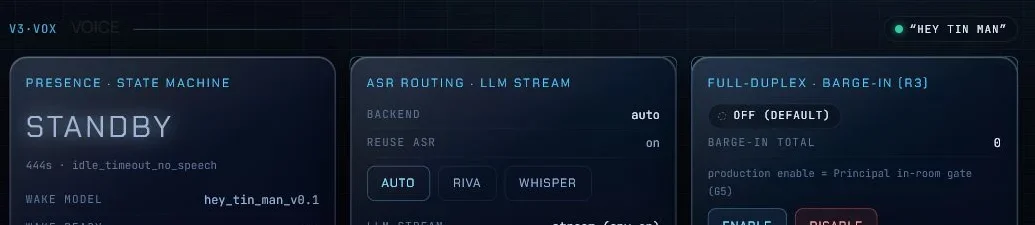
Wake detection, speech recognition, routing, reasoning and speech synthesis run on the sovereign node. English and Italian sessions, persistent dialogue and camera-description flows meet the same governed architecture.
WAKEUNDERSTANDREASONSPEAK
Full-duplex and barge-in remain visibly gate-controlled—not silently enabled.
Dialogue that persists
Spoken, typed and camera-assisted turns share a durable conversation surface instead of vanishing after each request.
Vision that can answer
The operator can ask what the camera sees; the multimodal core describes the current frame and identifies the responding model.
A voice on the node
Replies are spoken through Thor’s hardware speaker—not delegated to a browser or external speech service.
Governance in the interface
The cockpit can read the enforcement plane, but policy authority remains off-box and human-controlled.
THE DIFFERENTIATOR
Native NVFP4 across the entire multimodal stack.
Most edge AI quantizes only the language model and leaves the vision and audio encoders at higher precision. The NVFP4 foundation first proven in Tin Man v3.0 runs the full pipeline — vision (ViT), audio (Conformer), and the language head — in native NVFP4, runtime-validated on a single Blackwell-class device, in English and Italian.
The result: a complete sense–think–speak system resident on one embedded module, with memory and throughput headroom that usually demands the cloud.
PROVEN LIVE · PRODUCTION CUTOVER · 2026-08-22
98.22 tokens/sec decode. Same Thor. Same model.
TensorRT Edge-LLM 0.9.1 moves Nemo's matched batch-1 decode throughput from 39.01 to 98.22 tok/s—2.52× the previous runtime. Prefill reaches 9,945.4 tok/s while the LLM engine memory footprint falls by 1,262 MiB.
- 98.22 tok/sDecode throughput
- 2.52×Matched uplift
- 9,945.4 tok/sPrefill throughput
- −1,262 MiBEngine memory
NEMO · TENSORRT EDGE-LLM 0.7 → 0.9.1 · MATCHED QUALIFICATION
| Metric | Runtime 0.7 | Runtime 0.9.1 | Change |
|---|---|---|---|
| Prefill latency | 1,250.3284 ms | 205.9237 ms | 6.07× faster |
| Prefill throughput | 1,638.0 tok/s | 9,945.4 tok/s | 6.07× |
| Decode latency | 25.632 ms/token | 10.181 ms/token | 2.52× faster |
| Decode throughput | 39.01 tok/s | 98.22 tok/s | 2.52× |
| LLM engine memory | 18,569 MiB | 17,307 MiB | −1,262 MiB |
Method: batch 1, input length 2,048, past KV 2,048, output length 128, three warmups and ten iterations with CUDA graph on the same NVIDIA Jetson AGX Thor and the same Nemotron Nano 3 Omni checkpoint. Text, SSE streaming, vision, short and long audio, and supervised crash recovery all passed the production gate with zero Nemo request, vision or audio errors.
EARLIER VALIDATED PLATFORM FOUNDATION · v3.0
The gains that established the current multimodal stack.
The V3.0 migration first delivered +10–25% per-request gains. The V5 comparison repeats each workload five times on the production 0.9.1 runtime, excludes warm-up and reports the median: technical and long-form workloads now reach 90.909–92.191 tok/s.
| Workload | Prev. gen | V3.0 | V5 median | Δ V3→V5 |
|---|---|---|---|---|
| Short greeting (IT) | 19.9 | 24.3 | 63.025 | +159.36% |
| Short greeting (EN) | 21.1 | 25.8 | 57.895 | +124.40% |
| Medium technical (IT) | 23.6 | 29.4 | 90.909 | +209.21% |
| Medium technical (EN) | 25.7 | 28.3 | 91.065 | +221.78% |
| Long explanation (EN) | 25.2 | 30.7 | 92.191 | +200.30% |
Short greetings produce only 8–15 completion tokens and carry proportionally more overhead. The technical runs generated 159 tokens and the long-form run 255; a separate 511-token probe sustained 93.74 tok/s with GPU utilization at 93–97% (96% median).
Voice · streaming synthesis first-audio latency (ms)
| Workload | Prev. gen | V3.0 | V5 median | V5 p95 | Δ V3→V5 |
|---|---|---|---|---|---|
| Short (IT) | 192 | 146 | 99.198 | 103.551 | −32.06% |
| Medium technical (IT) | 176 | 144 | 102.394 | 253.748 | −28.89% |
| Short (EN) | 161 | 155 | 100.770 | 111.951 | −34.99% |
Ten repetitions per workload, warm-up excluded. Time runs from the HTTP request to the first 2,048 bytes of PCM. The V5 median improves first-audio latency by 28.89–34.99%; the medium Italian case includes one 371.856 ms outlier, reflected in its p95.
Perception
V5 live detector pipeline (camera + LIDAR sensor fusion) — 8.01 ms mean · 24.73 Hz. Against the published V3.0 figures (~7 ms, ~20 Hz), frame latency is approximately 14% higher while throughput is approximately 24% higher. The comparison is indicative because the original V3.0 raw protocol is not available.
Efficiency & telemetry
V3.0 measured ~58 W under LLM load. The V5 long-decode probe sustained 93.74 tok/s over 511 tokens with GPU utilization at 93–97% (96% median). No comparable V5 power sample was captured in this run.
CAPABILITIES
From multimodal model to governed operating system.
- 01
One model, three modalities
Text, image, and audio in a single on-device NVFP4 model.
- 02
Persistent dialogue and voice navigation
On-box speech, durable transcripts and EN/IT navigation across the Cockpit V3 operating surface.
- 03
Vision that answers
Camera and LIDAR perception plus natural-language description of the current visual scene.
- 04
Governed execution
Intent can progress from dialogue to completion only through signed policy, visible gates and explicit human authority.
- 05
Alchemi scientific co-pilot
Materials goals, governed campaigns, evidence tracking and human promotion gates.
- 06
Crash-durable production state
Sequenced boot, health matrix, recovery evidence and fail-visible operating status.
- 07
26-core cognitive fleet
Perception, language, reasoning, memory, science, operations and governance on one edge node.
COGNITIVE ARCHITECTURE
26 live cores. One governed cognitive fleet.
Tin Man v5 coordinates a 26-core live fleet on a single Jetson AGX Thor. The public capability map below groups the disclosed cognitive domains; the Cockpit V3 capture reported 25 healthy, zero degraded, zero down and one planned core on 12 July 2026.
Perception & Sensing
- vision — camera-LIDAR sensor fusion
- retina — visual perception (planned)
- brainstem — LIDAR sensor bridge
- lidar_driver — LIDAR sensor driver
Language & Voice
- nemo — multimodal LLM front-door (NVFP4)
- chat — conversational front-door
- riva — speech recognition + 7-language synthesis
- voice_agent — in-room voice agent
Reasoning & Memory
- prefrontal — decision router + intent
- conscience — on-device reasoning LLM (Odino)
- memory — episodic memory + retrieval
Action, Safety & Governance
- realtime — real-time scheduler
- motion — path planning (planned)
- guardian — safety & compliance enforcement
- conscience_observer — meta-cognitive audit observer
Science & Materials
- science — materials simulation
- alchemi_workbench — materials workbench
- alchemi_em — electromagnetic materials simulation
Platform & Orchestration
- gateway — strategic gateway
- cockpit — operator console
- agent — content-factory drafting
Public projection by cognitive domain. The current cockpit roster is26 live cores; restricted implementation detail remains outside this L0 surface.
ARCHITECTURE
Tin Man is how Shield Brain runs.
Tin Man v5 implements the Shield Brain deterministic AI control architecture on NVIDIA Jetson AGX Thor. Its 26-core fleet is sequenced, health-visible and separated into bounded operating domains, while governed execution remains subordinate to signed policy and human authority.
Shield Brain is the deterministic AI control architecture protected by a patent application filed in Canada (2025, pending). It defines the hardware-isolated execution model that guarantees safety-critical determinism under variable generative workloads — and Tin Man is where that architecture becomes operational.
TECHNICAL CONTRIBUTION
A 13-line wiring patch falsified a public-domain limitation.
Native NVFP4 across the vision and audio encoders wasn't free. A public-domain inference held that TensorRT could not parse NVFP4 dequantization for encoder architectures (ViT, Conformer), mandating BF16 fallback. We empirically falsified this. The apparent limitation was a small wiring gap in a post-export rewriter — present in the LLM export path but not the encoder path. Once wired through, the encoder ONNX parses cleanly and the engines build natively in NVFP4.
That fix became the measured quantization foundation carried into Tin Man v5 on JetPack 7.2. The fix-pattern, popularly cited as the 13-line wiring patch, applies as 12 insertions across 6 files in the TRT-Edge-LLM rewriter layer, and is reusable for any NVFP4-quantized encoder architecture.
We documented the finding and prepared a bundle of six atomic patches for upstream contribution to NVIDIA TRT-Edge-LLM.
13 LOC
popularly cited (12 insertions across 6 files, precise)
+331 / −63 LOC
total atomic patch bundle for upstream
6 patches · 3 rounds
NVFP4 encoder export wiring · prepared for upstream
PLATFORM
NVIDIA Jetson AGX Thor — Blackwell embedded.
- NVIDIA JetPack 7.2
- TensorRT 10.16.2
- CUDA 13.2
- Blackwell (sm_110a)
- 128 GB unified memory
- GPUNVIDIA Blackwell embedded (sm_110a) · 80 Tensor Cores Gen 5 · 2560 CUDA cores
- CPU14× Arm Neoverse V3AE + efficiency cluster
- Unified memory128 GB LPDDR5x · ~273 GB/s bandwidth
- StorageNVMe PCIe 5.0 · ~14 GB/s sequential read
- Software stackJetPack 7.2 · CUDA 13.2 · TensorRT 10.16.2 · native NVFP4 runtime
- DeploymentContainerized · sovereign-by-default · controlled egress remains policy-gated
GOVERNED EXECUTION · DEFINITIVE L3
Capability advances. Authority does not drift.
Tin Man v5 can take an authorized objective from spoken intent through reasoning, tool use and completion while preserving signed policy, physical safety boundaries and explicit human gates. L4 physical autonomy is not inferred from L3 capability; it requires a separate, explicit human-authorization decision.
ECOSYSTEM
NVIDIA Inception member. Ready to contribute upstream.
Reinventy is a member of the NVIDIA Inception program. Tin Man v5 carries forward the full multimodal NVFP4 stack first runtime-validated in v3—including encoder paths the official NVIDIA reference recipe did not quantize natively at the time of measurement.
The encoder NVFP4 export-wiring fix documented above is reusable beyond Reinventy's own deployment, and we have prepared a six-patch bundle ready for community review.
ENGAGE
Capability briefs are released under partnership.
The v5 definitive-state report, Cockpit V3 capability brief, measured v3 performance foundation, upstream patch context and integration roadmaps are released under non-disclosure agreement. Reach out and we will route the conversation to the technical lead.
Direct: engage@reinventy-solutions.ca